Ben Shahn
1898 – 1969
The social-realist painter who documented Depression-era America with a hidden camera
Ben Shahn was born on September 12, 1898, in Kovno, then part of the Russian Empire and now the Lithuanian city of Kaunas, into a Jewish family. His father, suspected of revolutionary activity, was exiled to Siberia, and in 1906 the family emigrated to the United States, reuniting in the Williamsburg section of Brooklyn, New York. As a teenager Shahn was apprenticed to a commercial lithographer, a trade that gave him a lifelong feeling for line, lettering, and the printed image.
Shahn studied briefly at New York University and City College before enrolling at the National Academy of Design. In the 1920s he traveled twice through Europe and North Africa, absorbing the work of the old masters and of modern painters, but he came to reject pure aesthetic abstraction in favor of an art rooted in social and political life. His breakthrough came with a series of twenty-three gouaches, "The Passion of Sacco and Vanzetti," painted in 1931-32 in response to the controversial execution of the two Italian-American anarchists; exhibited in 1932, the series made his reputation as a leading American social realist.
In 1933 Shahn assisted the Mexican muralist Diego Rivera on the ill-fated mural for Rockefeller Center in New York, an experience that deepened his commitment to public, politically engaged art. Two years later, in 1935, on the recommendation of his friend Walker Evans, Shahn joined the photographic unit of the Resettlement Administration—soon reorganized as the Farm Security Administration (FSA)—directed by Roy Stryker in Washington.
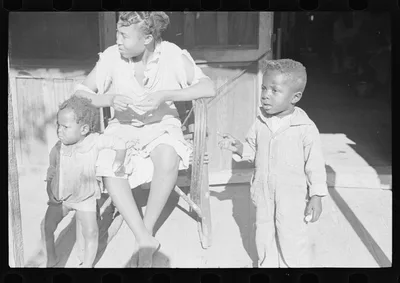
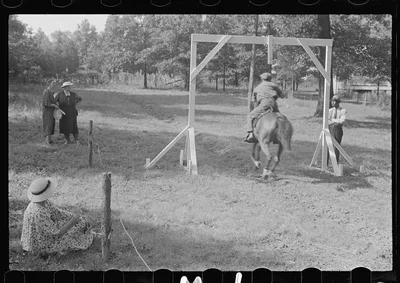
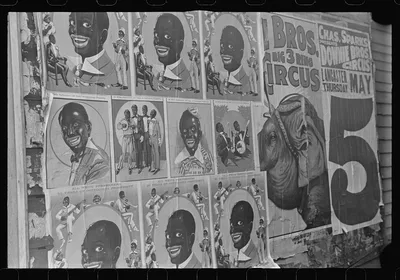
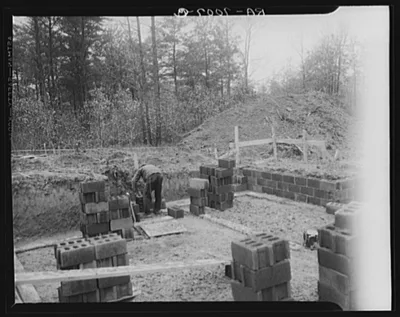
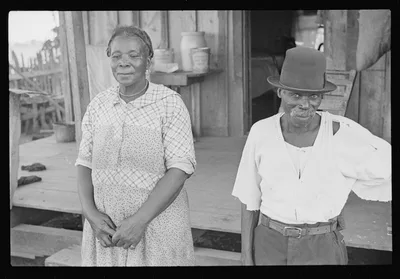
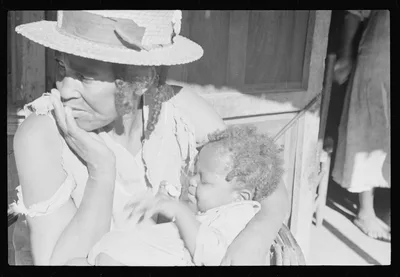
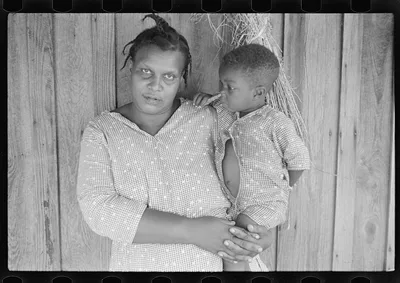
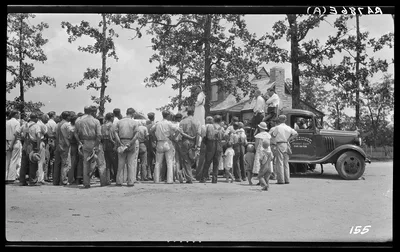
Between 1935 and 1938 Shahn traveled through the American South and Midwest making documentary photographs of Depression conditions: cotton pickers in Arkansas, miners' families at Scott's Run in West Virginia, a medicine show in Tennessee, and the main streets, county fairs, and amusement parks of small-town Ohio. He worked with a 35mm Leica fitted with a right-angle viewfinder, a device that let him aim the lens to one side and photograph people candidly, without their awareness. Although his time in Stryker's unit was relatively brief, his roughly six thousand negatives became one of the most distinctive bodies of work in the FSA file.
Shahn's federal work was not limited to the camera. He designed posters and painted murals for New Deal agencies, including a fresco for the planned community at Jersey Homesteads (later Roosevelt), New Jersey, completed in 1938; murals for the Bronx Central Annex Post Office in 1939; and a mural for the Social Security Building in Washington in 1942. During World War II he produced graphics for the Office of War Information and the Congress of Industrial Organizations.
In the postwar decades Shahn was celebrated as a painter, printmaker, and graphic artist. The Museum of Modern Art gave him a retrospective in 1947, and in 1954 he represented the United States at the Venice Biennale alongside Willem de Kooning. He served as the Charles Eliot Norton Professor at Harvard in 1956-57, lectures published as the influential book "The Shape of Content." Ben Shahn died on March 14, 1969, in New York City, at the age of seventy.
A Career in Images
"I hate injustice; I guess that's about the only thing I really do hate."
— Ben Shahn